Catherine Stine's IDEA CITY

Welcome Visitors

Monday, April 9, 2012

H is for History in Fiction

A Medieval Witch
Today for A to Z Challenge I'll talk about history. In high school, I was often bored by history, or at least the way that my history teachers approached it. So, when I got a job teaching college lit, and was told I'd have to lecture on the historical periods surrounding our texts, I was petrified. For instance, I recalled next to nothing from high school Greek history. I actually went to B & N and bought Greek History for Dummies. I'm no dummy, but I needed a quick shot. Turns out that there is a way to make history come alive. I do that in large part through talking about the odd moments that stick in my mind. Here are a few, from the Greek period through to Elizabethan.

The big hypocrisy of Pericles' radical democracy in Athens was that while women were not even allowed citizenship, men had to prove that their mothers were born in Athens to prove their own citizenship! Also, Athenians and Spartans had a rivalry in more than just fighting style-they were jealous of each others' fashions and the fact that Spartan women could work out in gymnasiums and have multiple lovers!

In Medieval times, people believed that gap-toothed women were highly sexed, and that a pimply man had a flawed soul. This was a time when people were truly judged by surface appearance.

In Dr. Faustus, written during the Elizabethan period in England, there is a reference to Native Americans as "Spanish Moors". This proves that people "across the pond" were quite aware that the Spanish were lording it over the Native American Indians in what's now America. Also at that time, white and black magic were seen as coming from the bible. People believed literally in the devil, and prayed both to God and Night Hags!

It's fun to learn about history, and quite helpful when contemplating writing an historical novel or fantasy. I considered my first YA novel, Refugees, about the friendship between and Afghan boy and an American girl, historical fiction, even though it was about contemporary matters. The reason? It dealt with the fallout from 9/11, which immediately made it a pivotal point in history.

If you were writing historical fiction or fantasy, which period would you love to set in in? Which historical periods interest you the most?


Friday, April 6, 2012

G for GERMINATE

Today for the A to Z Challenge I'll ruminate on germinate. It generally means "to come into being" or "to grow". From the Latin, germinatus, to sprout. First used in 1610.

I love to garden and I love to write. Both require germination. Seeds need sun, moisture, a thin layer of dirt and time. In story germination, one needs to free-write, outline, research and do lots of lucid dreaming.

One helpful tool for plant germination is eco-friendly plant fabric that lets in sun and water, yet keeps temperatures warm and pests out. A helpful tool I've found in organizing nascent story is the Scrivener corkboard feature, with its virtual Index cards on which you can "jot down" plot points and then reorder endlessly. Find out about Scrivener here.
The Scrivener Virtual Corkboard
Seedling Tray

When plants get bigger and outgrow their seedling trays, they must be transplanted directly in the soil. When a story gets richer and more fully fleshed out, one must plant it firmly in a laptop file, and plow straight ahead to the end, only to go back to the beginning and revise. Both need love, patience and smart pruning.
The Voynich Manuscript, from around the Renaissance

Perhaps, you'll combine writing and plant images in a mysterious tome, such as the Voynich manuscript, which depicts alien plants and a blurb in a language that no code breaker has yet figured out. No kidding. Check out this Smithsonian site.
But first, leave a note about what germination means to you. How do you grow your plants, your story, your life?

Thursday, April 5, 2012

F is for Forest.

The Fur Family
F stands for FOREST in the A to Z Challenge. The forest holds a sweet spot in fiction. It's where Winnie the Pooh and Bilbo Baggins, Gandalf and the Fur Family all live. It's where Hansel and Gretel are lured to the witch's house, and where the seven dwarves work. Forests are beautiful, mystical, healing, yet they can also be frightening places where wolves hunt, coyotes raid, black bears prowl and vampire bats sleep hanging
from trees. If you look hard enough, you can find magical eggs in the crooks of tree branches, and elves drinking dewdrops from snowdrop cups. You might even find the entrance to a secret underground vault if you push aside twisted roots. Or the hole in the tree trunk that Alice fell into to find Wonderland.
Bilbo Baggins

Hansel and Gretel
Go, then, authors, into the forest. Smell the scent of turpentine pine and wet moss, feel the crunch of twigs underfoot, witness paisley patterns of light shifting over leaf cover, and the deeper shadows of troubled spirits that haunt the toadstools and rotten parts of fallen wood. Listen to the chatter of chipmunks and the crack of broken nuts. Wander down to the stream and take a place there. Close your eyes and dream.
What is your forest dream? Which characters do you see there?

E's for Eccentric Characters

Pippi Longstocking
Franz Kafka


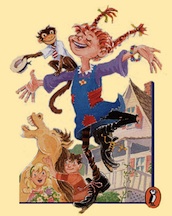
In the A to Z Challenge it's E day. E is for eccentric characters. They are almost always more interesting than the bland, perfect heroes and heroines. Who do you remember most from Peter Pan? For me, it's Captain Hook. He's murderous yet cowardly, and terrified of the croc who is constantly after him. Consider Pippi Longstocking, a highly unusual little girl with stick-out red braids. She lives all alone, has the "strength of ten policemen", hangs out with a monkey and her main possession is a suitcase full of gold coins!

Sherlock Holmes
Or take Sherlock Holmes, a brash, even rude genius, who can't quite figure out a love relationship, is a violin virtuoso and is prone to fits of despair.

Disney's Captain Hook
Kafka's extreme performance artist in his short story "The Hunger Artist" is so devoted to fasting that he lives in a cage for days, weak and crouching. Perfecting his art would mean fasting to death. Now that's an odd and macabre kind of eccentric.


Who is your favorite literary eccentric? The creepiest one? The most charismatic or mysterious?

Wednesday, April 4, 2012

D is for Gustave DORE, Book Illustrator with Soul

Gustave Dore
Today is D in A to Z Challenge. As part of theme Creative Life I'll talk about the incredible French illustrator, Gustave Dore (1832-1883). This man created engravings for some of the world's most beloved literature: Milton's Paradise Lost, Dante's Divine Comedy, Fables de la Fontaine, Edgar Allen Poe's The Raven and Dore's illustrated Bible.

At the age of five he was noted for pranks, but by fifteen, he was regularly employed as an illustrator in Paris. He's most celebrated as an artist who created dark dreamscapes, as seen in his depictions of Satan, and the eerie pictures in Poe's Raven. He is also a master of landscape as a powerful backdrop for leather-winged angels and demons. He continues to inspire book illustrators-from N. C. Wyeth, to Brian Selznick. Let the illustrations conjure up their own magic for you.
Which is your favorite? Why?
The Raven
Satan from the Divine Comedies


The Hare and the Frogs

Little Red Riding Hood

Tuesday, April 3, 2012

C for CONTINUITY

Today for A to Z, it's C Day.  C is for CONTINUITY. The dictionary describes this as: 1. uninterrupted connection, succession or union. 2. a continuous or connected whole 3. a film, musical piece, or story in chronological order. From the Middle English (1375-1425) continuite --flow or progression.

As a writer and teacher of fiction, I am very aware of the importance of maintaining continuity. I often write on workshop students' pieces "Give us more connective tissue." What do I mean by that? Perhaps a novel is too episodic, and the episodes don't connect enough, or perhaps the characters are each going on their own paths and not bouncing off each other in a tight action/reaction dance. Or the main protag's challenge has little to do with the theme of the story.
Alex Grey, Visionary Art

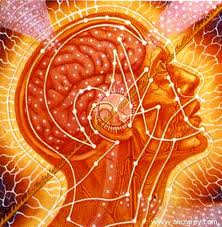
Think of a body. It has a heart--the story core--and it has parts that each do their duty. In a body, without connective tissue, the muscle that holds the body together, or lymph that pushes out toxins, or the blood that feeds and oxygenates, the parts would loosen and fall apart. The main characters' wants and needs should weave together in a complex design, and the story should have a clear, arching trajectory.

Think continuity!

What do you think is important in pulling a story together as one whole?

Monday, April 2, 2012

B is for Bottom Line in the A to Z Challenge

Let me start by saying that I've settled on a theme for the A to Z challenge. I'm writing posts on The Creative Life-anything about writing and art, and how to live as fruitfully as possible as a creative being, not always simple in the world of commerce, competition and fast paced-moves.

Now for B! The first thing that popped up for me (repeatedly) when I thought of B is the phrase Bottom Line. The dictionary defines it as 1. The essential or salient point, 2. A line at the bottom of a financial statement that shows the net profit or loss. 3. The most important consideration.

In considering a truly creative life, here is my bottom line:
Live by my intuition... if it feels right, go for it, no matter my anxiety. If it feels wrong, don't do it, even if the choice seems glittery and golden.
I have followed my intuition in editing a manuscript and sensing when it's done, in choosing an agent, in choosing a gallery, in using or not using manuscript critique suggestions, in choosing friends, even in buying a car or a piece of real estate. If an artist or writer cannot trust his or her intuition, he's working without a rudder.
The medieval cups are symbolic of intuition

To help me in this path, I often meditate before I face an onerous decision, or if I find myself unsure and waffling. This always helps. I might find that my gut is saying wait, you're not ready to make that decision, or it might tell me get on that phone now and stop procrastinating!

In your creative life, what's your bottom line?